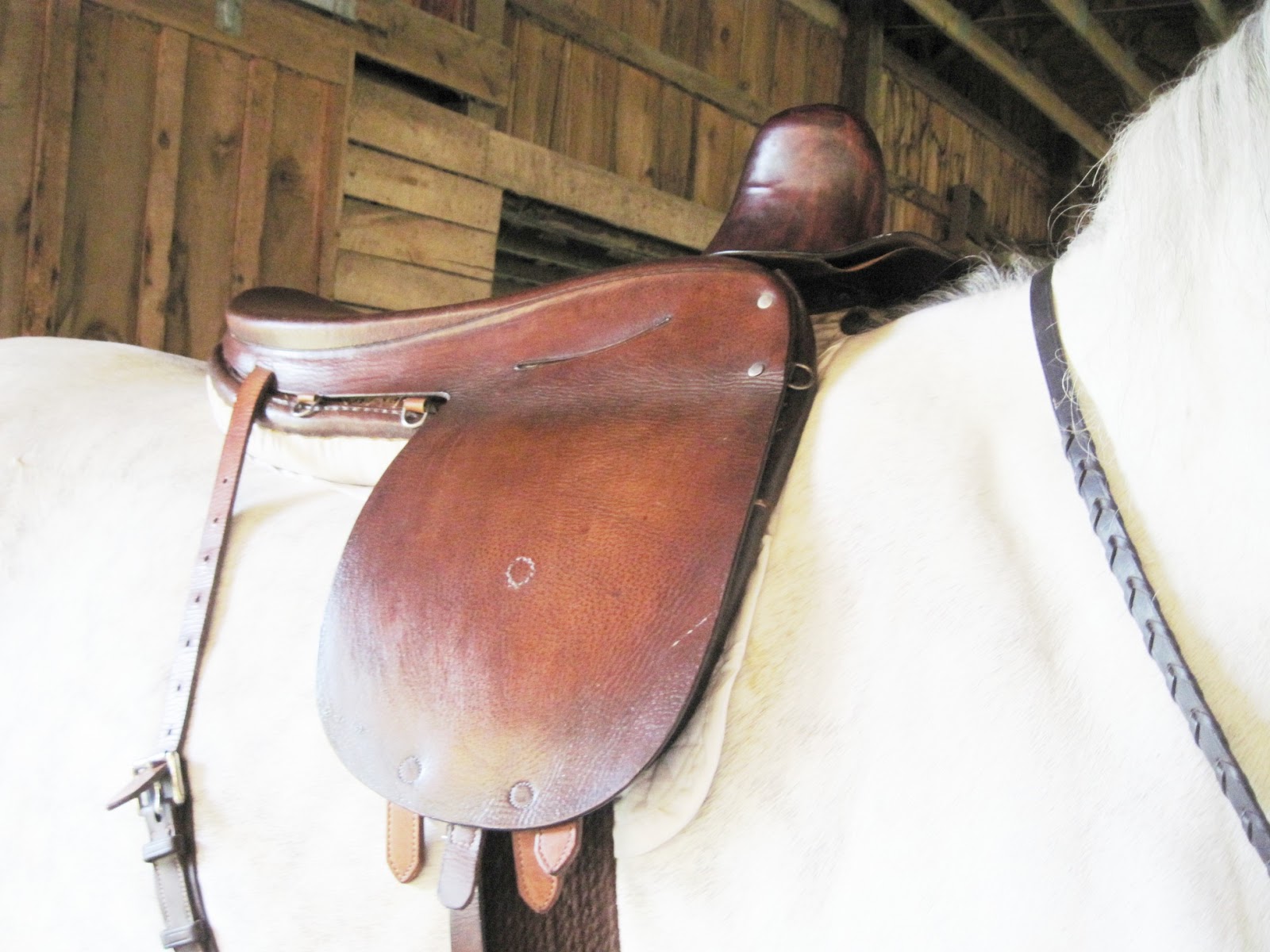
After longeing and riding (briefly) the saddle seems to sit down better. I will take more photos tomorrow after riding.
Wednesday, August 15, 2012
The Mayhew Lissadell
After longeing and riding (briefly) the saddle seems to sit down better. I will take more photos tomorrow after riding.
Wednesday, August 8, 2012
The Side Saddle Adventure Part II
Last September, after a particularly awkward and discouraging ride, I realised that I was wasting my time with my Martin and Martin as it just simply didn't fit my horse or me very well. I mulled it over for awhile, and in the end of October, I sent it on it's way to the Side Saddlery on consignment. Linda Flemmer gave me an honest appraisal of it and even after her consignment commission, I would be getting more back on the saddle than I was prepared to take.
Sending it to an expert on consignment proved to be the correct decision and by February it was sold. In fact, I ended up with almost all of my initial investment back, and the price of the experience was only the freight in purchasing the saddle and then sending it to her on consignment. Furthermore, I am confident that the purchaser was well guided in selecting and fitting the saddle and that it will have good care. That is always a consideration when dealing with these lovely old maker saddles.
Months wore on and I saved my pennies. Well, I spent most of my money on horses and wine... the rest of it I just wasted. I remained in touch with the other passionate side saddle lovers through our fabulous Facebook group, but not having a saddle to work with was very disheartening. Now and then I would check the classifieds, but I did not muster the determination to start again. I did not scour the countryside, nor did I actively send out inquiries. I watched as others posted news of exciting purchases and their hopes and dreams and I waited.
Then, I saw a nice Mayhew Lissadell come up for consignment. http://sidesaddle.com/store/saddles/saddle_page/mayhew_9.html I went ahead and inquired, took a brand new Wither Tracing and sent it to Linda. There was not a great deal of difference between the one from last fall, and the current one. Just a little more dip in the pocket right behind his shoulder blades. Linda confirmed that this saddle tree appears to be a good basic size and shape for Grey, and the 23" length, and generous 14" width sound promising for me.
Keep your fingers crossed. Taking the plunge purchasing a side saddle is a little easier this time, because I know a little more, and I know that quality old name saddles, especially larger ones, hold their value and that I am spending mostly freight and consignment fees each time I purchase another one. That reduces the risk as long as you work with ethical and experienced people, which I am confident Linda is.
But at the same time, there is trepidation... will it fit? Will we all three be compatible? Will everybody be happy? What new, unconquered challenges will this one pose? I am not eager to have another "not quite right" saddle sitting in my living room staring at me accusingly saying "This whole idea of yours is nothing but folly". "Your thighs and your horse are far too unique a combination to ever hope of finding just the right match". "These old saddles were custom made for upper class women with a larger disposable income than you have." ....And on and on and on... and they never shut up.
So, this saddle is coming on trial. Linda's policy allows a test ride with a full refund of the saddle price upon its return in the same condition within 7 days. Yes, you do have to pay for the shipping and insurance each way. And no, it is not easy to get a box the size of a side saddle into the car to take it to the UPS to return it. But this is the price we pay for passion. Send good thoughts our way!
Wednesday, December 14, 2011
Christmas Shopping
What caught my eye first was the grey horse ridden aside. But I am slow to pick up "dustables" as our house is small and already full.
The back has the first verse and chorus of the hunting song "Do You Ken John Peel" which interested me. but, the final stroke was that when I inspected the signature on the art, it was the same last name as my own. Oh very well! I'll take it.
Thursday, October 13, 2011
Random Rainy Day Riding Related Thoughts
Back in the 1980s when Dad was hauling us, sometimes to two shows a weekend with two sets of horses, we were not allowed to take anything out of the rig during the week lest it come up missing on show day. We could outfit ourselves in flawless hunt seat, saddle seat or western garb at a moments notice. In fact, I once amused myself by showing my grey, appaloosa, heavy hunter in saddle seat attire next to a Saddlebred in a Pairs Pleasure class and won. And there was the time, to fill a qualifying class for a friend, when I showed my sister's Saddlebred mare western in a pair of chaps so outgrown that I had to be airlifted onto the horse and stuck on like a clothes pin because I was unable to bend my knees. It went brilliantly, but I almost upset the apple cart coming in a close second to the intended qualifyee. The critical point being the flying lead change on the second canter while the mare tried to figure out what neck reining was.

I remember packing for my first show when I was 7 years old. I remember having to clean my double bridle. No 7 year old wants to clean a double bridle. Much less reassemble it. My mother had tailored my second cousin's cast off green corduroy suit to fit, and borrowed a derby several sizes too big, which got rained on and scooped off my head from the rail mid class. That was the first of a hundred rainy horse shows in my life. My saddle was a vintage Barnsby saddle from before cutback lane fox saddles became the norm. We still have that saddle. It has a wonderful patina, much like my side saddle. It's a family heirloom of sorts.

What I wanted to do was ride three gaited saddle horses. I grew up going to the World's Championship in Louisville every August which is on par with the fanciest horse shows the world has to offer. My first, muddy, backyard show was a far cry from that and to say I was disillusioned is an understatement. It was another ten years, and several horses later when I finally got my three gaited horse and the fancy saddle suit I had been dreaming of. Mom made the formal jacket out of winter white Pendleton wool. I always loved the formal jods with the ribbon down the side, and the bow tie and cummerbund. I finally parted with the top hat a year or two ago, selling it to Julie for one of her side saddle habits.

When I became an adult, we stopped expecting Dad to haul us, and my sister and I, in our brave and highly motivated 20s, hauled horses all over 4 states in this rig. This was my first solo run. Mom, my sister, and grandmother had gone ahead with a load of hay and shavings, and after work I loaded my sister's horse, and my Hackney road pony (and the sulky on the roof) by myself and drove two and a half hours to join them. Packing was always part of the fun. We were well equipped and set up with a carpeted tack room, sharing stall curtains with a friend. Each show was an adventure. It was years before I realised vacation time could be taken for anything but horse shows!

We continued to show several seats. I love good fabric, and traditional attire. The fun of showing saddle seat is coordinating your shirt, tie and vest. And the fabrics for jackets. Mmmm. Somewhere I still have a bolt of cornflower blue plaid from back in the day when plaid day coats were the "thing" to wear. We just never got around to putting it together. And hunt seat, with the boots.... I love a good pair of tall boots. I've even worn my field boots, with a dress, to the office. **Shrug** You have to break them in somehow.
The Horse Show MomAfter a decade of being away from horses, I got back into showing briefly, to take Grey to the county fair under hunt tack. The first time I rode at home in tall boots and breeches, I fell off within the first 50 feet. I kid you not. I got on, started to walk, and was thinking "it doesn't feel like my heels are down in these boots" when Grey pulled his signature spook and spin left. Slick leather does not grip the same as suede half chap, and before I knew what happened, he had jumped out from under me. I literally bounced off his rump and landed (whooompfh) on my fanny in the sand, my feet stuck out in front of me.
This past summer I've noticed a funny thing about dinner parties and introducing myself to strangers. When I say I "ride side saddle", and "go fox hunting" (yes, only once but I shall again, despite the fact that fox hunting requires awaking before the sluggish autumn sun rise, which I highly disapprove of) it some how transforms me in the person's mind from silly house wife with large, impractical, pooping pet horse to some sort of mythical, feminist Annie Oakley character who drinks her whiskey straight, then throws the glass in the air and shoots it to smithereens. Don't ask me why, but it does and I find it highly entertaining.
And then my husband will chime in with his account of the fox hunt. Yes, I toted my husband along on my fantasy vacation, and he went along with the car followers and got the quintessential fox hunting experience complete with two views of the fox, eccentric landed gentry, guests from England, and a score of horse crazy women who had caused domestic disturbances forsaking their husbands to join "the gals" for a weekend of drinking and hunting. It went something like this:
It was a windy day, and we had hounds EVERYWHERE. I heard that the huntsman lost the pack at least once. The fox was only mildy inconvenienced, and the whole thing played out like a farce. It actually lent a shade of the ridiculous to what I had always seen as a noble and elegant pursuit. That cartoon kept running through my head "which way did they go? which way did they go?". A good time was had by all, but mostly by the fox who was home laughing in his den at least an hour before the whips found all their hounds.
Saturday, October 8, 2011
The Wisdom of Wither Tracings
This blog entry has been many weeks in the making. One thing I have to say about the side saddle aficionados. You are all a most helpful and welcoming bunch.
Almost within hours of my posting my hoarder's dilemma entry, where I first spoke of moving on from this saddle to a possibly better fit, I found a very pleasant email in my inbox. It was from Sue Tobin of Side Saddle Heaven. She offered to help me in my search and suggested that perhaps my horse was simply not a Martin and Martin kind of guy.
Our conversation developed over the weeks of my sending a wither tracing, and her sending the results and explanations back. As I endeavored to fully understand the process, Linda Flemmer, from The Side Saddlery, was introduced into the email conversation through a clarification on point to point measurements. These ladies are patiently diligent in their explanations, and I have tried to be a receptive and understanding student. At one point I feared my blog entry may morph into an article, or worse, a whole book. Volumes could be written on saddle fitting. In the context of this blog, I hope, dear readers, to pass on some fundamental information that may be of help to someone just starting out. Someone like me who may have purchased, on a whim, the long dreamt of side saddle, or who is on the verge of doing so. You can read about tree measurements and wither tracings, but sometimes it doesn't sink in until it applies to your own situation.
The average shape of riding horses has changed over the past century. We have bred them larger and the overall shape has evolved over the years. For this reason, it can be hard to fit some of the larger well muscled, or over fed horses we ride today with a saddle designed 75 or a 100 years ago. And also, the principles of saddle fit have evolved. We all probably grew up reading cowboy stories where a well trained horse was easily distinguished by patches of white hair grown back from saddle rubs. That sort of horsemanship doesn't fly in this day and age. Heck, we now have equine dentists, chiropractors, and professional saddle fitters. Show up with a horse with rubbed hair, a girth gall, saddle sore or **gasp** fistulus withers, and see what kind of looks you get!
So, if you are new to side saddles, not an expert on saddle fitting, and don't have an expert within easy distance with a selection of saddles to try on... how do you be sure that tab A will insert into slot B? In other words...

How do you know that THIS...
...will fit into THIS?
Above is a diagram of a bare side saddle tree from the front, shown with a bare astride tree from the front. The aside tree is an older style tree with a considerably longer near side point for illustrative purposes. Click here for a series of photos on the ISSO site showing a bare Whippy tree with a bit shorter near side point.
Enter the Wither Tracing.
For starters, you will notice that the side saddle tree is built asymmetrically. The near side point extends further down the rib cage in order to stabilize the saddle and counteract the roll. when fitting, not only do you have to measure the gullet width, and the width between the shoulder blades, you have to somehow account for the curvature of your horse. Is he slab sided? Well sprung? Round as a barrel?
This link covers the basics of wither tracings for standard astride saddles.
How to create a Wither Tracing
(**Note: at a later date, I made a blog entry regarding making a "verified" side saddle wither tracing. Find it here.)
But, like I said, side saddles are more complicated. You can't rely on a simple triangle measurement. Side saddles are typically measured across the gullet from Dee Ring to Dee Ring, and from Point to Point. But the location of the Dees varies from maker to maker, and saddle to saddle. And I think I would have to have a degree in geometry to understand how a diagonal measurement across my horse's barrel could tell me anything useful without knowing a lot of other measurements and angles. I learned to spell the word "hypotenuse" from Sue.
That will get you part way. But how do you take into account the degree of curve of the near side point? You know, the one that keeps your saddle from rolling off? How do you know the saddle tree curve will fit the horse curve? This is a problem that is thankfully absent from astride saddles.
Sue asked me to send her a "verified" wither tracing. Not just any wither tracing. There are two important points you need to be aware of. First is that you need to use a 36" wire to trace the curve of the ribs as far as the near side point will go. So a store bought artist's curve or your standard wire coat hanger will not be long enough. Secondly, after you cut the shape out of your card board, you have to put the scrap of cardboard back on the horse like a saddle to see if you got it right. If you didn't, back to the drawing board.
I always keep the backs of desk pad calenders around and they make great material for this project. When you trace the withers onto your cardboard desk calender back, you want to put the heavy glued spine at the wither tip as this will keep the cutout rigid when you put the negative space cutting back on the horse and you won't be bending it in the middle, rendering your verification pointless. Or, get a sturdy piece of corrugated that is big enough that it won't droop when you cut the horse shape out.
Then you need a long, flexible but stiff piece of wire. I raided my husband's garage for this and came out with some sort of ultra expensive coaxial cable I had to promise to bring back. I also used my artist's curve as a verification that I was not allowing the wire to sag between the horse and the cardboard. The artist's curve does very well at holding it's shape while the 36" wire is unwieldy and harder to manage. I took an initial 18" trace over the top and drew that on the board with pencil. Then I marked the center of the 36" wire with black marker, put that point on the mane line of his withers, and proceeded to shape the wire to the best of your ability. This may take some time.

Here is my big, round, well sprung barrel of a horse.

I transferred the form onto mail friendly newsprint paper, marking the near and off side and wrote my full address and William's data as well as the date the tracing was taken, and mailed it off. Then I waited eagerly for the results.

Sue made copies of my wither tracing and superimposed the tree templates she has made from her inventory of saddles, choosing the larger seat sizes which have the best chance of fitting me. She sent me both examples of trees that would fit, and trees that wouldn't. You can see how the trees in the above photo do not sit down on the withers. This will allow the saddle to roll in the direction of the arrow.
Sue's tree template is made by setting the saddle back on it’s fanny, and separating the padded panel extension and the near side flap to expose it’s ‘nether regions’. This enables the her to follow the line of the tree, bending a wire to match, until an accurate representation of the tree itself, without padding, is achieved. Then, she superimposes the tree template over the wither tracing, using her years of experience to judge how this tree would sit on this horse's back.

This is the only long distance method for predicting whether the tree and the horse have a compatible curve. Note the purpley line that ends highest up in this photo. This tree is still curving inward where Grey's ribs are curving outward. This creates a pressure point. That line also happens to represent a Martin & Martin Tree. Guess what I bought? A Martin & Martin.

What you want is a tree like this which is wide and smooth enough to follow the curve of the ribs, as both this Owen and this extra-wide Champion and Wilton tree do. The tree is still curving outward with the horse, and the top of the saddle is settling down over the withers not perching above them.
This is harder to see on the near side because the safe covers a wider area.

But when I ran my hand ALL the way around the saddle I could clearly feel the pressure point. The tip of the tree pushed down on my knuckles. The rest of the front of the tree, all the way across was comfortable and easy to slide my hand in, but that tip is a problem. Not only is it uncomfortable for the horse, but it prevents the saddle from settling down properly. It is part of my uphill problem. No matter how much flocking is taken out of the pommel, if the hard tree is too tight at any point for the horse, the saddle will not settle or sit straight. And if the saddle will not settle down on the withers, we are going to continue to have the saddle roll to the side.
Not to mention how that must feel when you hang one hundred and mumblemumble pounds of rider on it.
Tuesday, October 4, 2011
Bareback Riding

Last New Year’s I hung up my stirrup irons, then eventually put away my saddle completely, and rode bareback until spring. I’m starting a little earlier this year. I began wishing for a side saddle when I was about 15 or 16. But, I’ve wanted a bareback pad since I want about 10. I finally bought myself one. The 10 year old in me really wanted a green one, but I thought William would look more distinguished in black.
My reason for buying a bareback pad, was not so much to give me traction on the horse, but Mr.W.P. Grey seems to find the feel of my thigh muscles gripping his bare back at the canter either strangely provocative or down right annoying, because eVeRy.TiMe.We.CaNteR: he bucks. If he doesn’t start out crowhopping, he ends crowhopping, and when he gets like that he is not easy to pull up.
He has a big, bold, ground covering canter, and we have worked all summer on a smooth, loose reined transition. If I stay out of his face and leave my legs off him, he will step off quietly and lope along smoothly like a top notch western pleasure horse. If I get a little tense and interfere, he gets chargey and it’s off to the races. Then he might slip or trip on less than perfect footing, which makes him mad, and conditions have been known to disintegrate from there. This is all more likely to happen when I am bareback and clinging for my dear life. If I am ever going to canter aside, we need to work this out.
I feel riding bareback has a lot of comparisons to riding aside. You need core strength and to develop independent balance, and you have to trust your horse. You have to be aware of your seat bones and keeping one on each side of the spine. If you hold tension in your upper body, your shoulders will end up somewhere around your ears and you may be inclined to flap your chicken wings ...ummmm I mean elbows. You cannot rely on stirrups for anything.
I’ve just completed my second ride with the bareback pad. The first ride Grey was very careful of me, jogging along like he was giving a pony ride. This is a little strange considering his frequent delight in seeing if I am truly paying attention and have my heals down.
Today was cool and brisk and I had a snorty horse under me. But, he was obedient and had a lot more impulsion at the trot allowing me to work on keeping my shoulders and chicken wings down …and keeping one seat bone on each side of his spine. Yes, I can feel his spine through the pad, and I was surprised how often my seat bones went astray, twanging on the spine which I sure is not pleasant for the horse either.
I was able to get my calves off his side and let my lower leg hang properly. By the end of the ride, I was stretching my legs down and back and lengthening them along his side instead of perching with my knees too high. He went along at a very nice, straight medium trot, not behind the vertical and generally giving me everything I work so hard for in my dressage lessons and daily ride without my asking. And I haven’t figured out exactly WHY other than I was concentrating on my riding, not him. And we all know the root of all riding problems is the rider, not the horse.
Both rides we cantered on each lead uneventfully with no dolphin moves or pronging like an antelope, and he seemed quite pleased with himself. After 20 minutes or so in the ring, we headed out the driveway and up the road. This was an exercise in trust. He is generally better behaved out of the ring than in it, but the nervous adult re-rider in me says that cantering up the road bareback is a risky endeavor if not plain stupid. We trotted and had a short canter. We are baby stepping our way to more confident and balanced riding in order to ride aside that much more elegantly.
Monday, September 19, 2011
Antiquing

My husband and I went on an antiquing extravaganza this weekend. Since we weren't far from the venerable Genessee Valley Hunt Club, I was hoping to find something side saddle to buy. There were the usual selection of large and proportionally boring hunting prints but finally, I struck paydirt in a box of post cards.
Hello Ida Margaret,
How do you and Harold and Chauncey like it over at the farm? I suppose you are riding your father's horses like this girl does.
With love to all from,
Mary somebodyorother
It seems the sides have been trimmed, probably to remove a century of fuzzy edges. Postcards are fun, even when they're addressed to someone else.
I eventually found a bamboo and deer antler riding crop, but for $40, it wasn't in the best condition. The tip was gone. It must have been wrapped with string or leather at one time. Since I've never taken the time to educate myself on prices and such, I didn't want to rush headlong into it for $40. At 25 or 30, I probably would have, and I'm not missing it too badly today.
It was short, no longer than 24" so I'm thinking it could have been a child's crop. It was labeled as a "gad about cane" silly people! It had a sterling silver ferrule on it, engraved "Julia Marie Batavia, NY". At it's length, it wouldn't have been useful to me other than for display. Perhaps, if it is still there next time I will feel differently.