Wednesday, November 20, 2013

Friday, June 14, 2013

Pretty Kitty Herrick


As I pass the time side saddle-less, I have delved a little deeper into old books available in online versions and found quite a treasure.  I have enjoyed reading such hunting authors as David Gray and Robert Surtees.   It is completely by chance and Google recommendation that I ran across the English author Mrs. Edward Kennard.  

Mary Kennard wrote in the end of the 19th century and concentrated on sporting subjects such as fox hunting and fishing.  I began with her “SportingTales” (1893) a collection of romantic shorts, moved on to “A ProfessionalRider” (1903) and then struck gold in “Pretty Kitty Herrick the Horsebreaker” (1891). 


If you enjoy Jane Austen you will love “Kitty Herrick” which runs along the lines of Jane Austen’s Emma only with the strong equestrian theme.  The heroine, Lady Katherine Herrick, suffering a cruel and unexpected reversal of fortune,  opts to go “into service” as a lady horse breaker finishing and selling ladies horses for the local horse dealer to earn her way while her secret engagement to a poor but handsome (gold digging) gentleman is resolved.

The author’s use of the hunting field and horse training are accurate and enjoyable, particularly to a side saddle rider.  Unfortunately, we do not get any particulars about her saddle, but we do know that Kitty wears a brand new Busvine habit out cubbing.  Side Saddle readers can relate and any reference to riding style will catch our eye as we find that Kitty is well admired for her straight back and excellent position in the saddle and has “exquisitely light hands”.


  I will certainly be searching for more of her novels in print which are not available online so I can again be swept away into the English Countryside.  The Girl in the Brown Habit looks particularly promising.


Wednesday, January 9, 2013

Selling a Side Saddle

One thing I've learned in my search for a saddle is that not everyone selling a saddle knows what a buyer might be looking for.  Trust me, if you are selling a saddle, "long seat" and "wide tree" are not going to satisfy my inquiries.  I need the best actual measurements I can get.  With the nearside long point the SHAPE of the tree is every bit as important as the WIDTH of the tree.  And the only way you can even begin to make an educated guess at what that might be, you have to start with some measurements.

 A high percentage of saddle shopping takes place long distance either by email or phone and often with several time zones, and ocean, and cultural barriers in between.  Communication issues will arise.  So, in the interest of buyers and sellers everywhere, both educated and inexperienced, I thought I would put out a few tips of what I need to know with photos to improve my communication options.  It is also important to know if the measurements are being made in centimeters or inches.


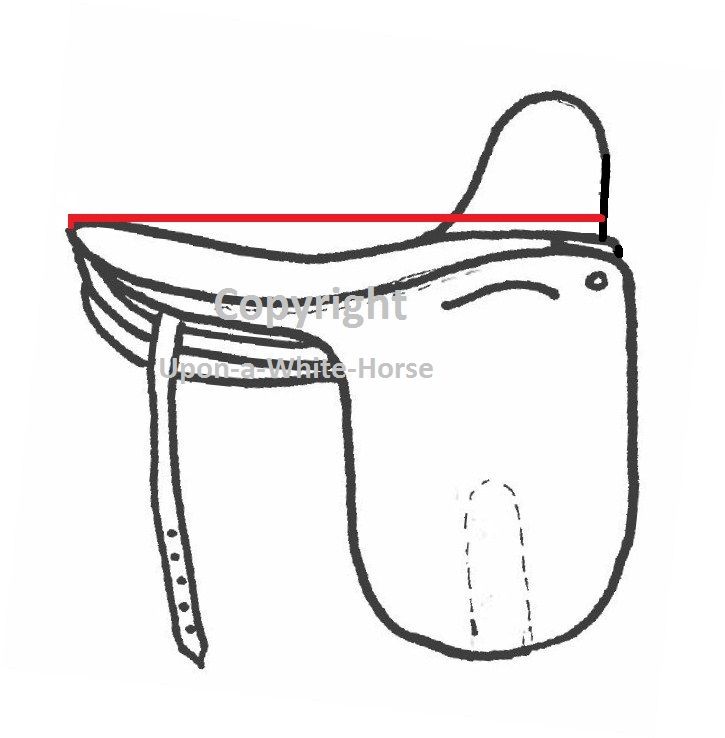
1. Length of seat, in inches. From the front of the fixed pommel to the center of the cantle. This is the American method of measuring. The English method involves the measurement from the cutback to cantle, but even the English will admit that the American method is more practical when matching to a rider measurement.
Most saddles seem to be around 21" to 21.5". So we'll consider that an "average" size seat. Taller riders, 5'8" and up, with longer legs, will be shopping in the 22" to 23" length. These saddles are harder to find and come at a premium. Demand exceeds supply. A nice quality longer saddle with a corresponding wide tree to accomadate the taller lady's larger horse may run as much as $1000 more than an otherwise identical saddle of a standard length.
The more petite ladies, 5'5" and under, will be looking for the 19" and 20" saddles. These are also harder to find.


2.  Width of seat at the widest point.  This can be anything from an average 12" to 14".  Generally, the longer saddles (22" to 23") will run in 13" to 14" width to accomadate the wider frame of a taller woman, and does not necessarily correspond with gullet width.  The smaller saddles may have a width around 11".  The width of the seat is designed to put one seat bone on each side of the horse's spine, and no, they don't come in extra extra wide to accomadate "middle aged spread" of fanny.  The seat bone measurement is what we are trying to fit, not the fanny spread, although if the width of the saddle minimizes the appearance of the fanny spread, that is a plus!  The saddle may fit the pelvis, but if fat hangs over, it will appear that your saddle is too small.

3.  Gullet width determined by Dee to Dee measurement.  This is not a praticularly helpful measurement as dee rings can be installed at varying points on the tree, but it does help put things into perspective.  If you have a narrow gullet (short Dee to Dee measurement) and a wide Point to Point, you can expect the curve of the saddle to be markedly different than if you have a wide gullet and a short Point to Point.  For an example, go to the NEA Saddle Fitting page and scroll down to Tree and Gullet Width.

4.  Point to Point Measurement.  This seems to be the most difficult measurement for people because with some saddles you really have to struggle with the safe to find an accurate point to measure from.  The idea is to estimate the measurement from the inside of the tree surface on the off side point, to the inside tree surface of the near side point.  It is NOT the measurement from the inside of the padding, and can be hard to achieve on some saddles.

On the Lissadell saddle pictured above left, I have hightlighted the points, easily visible in their leather pockets.

A narrower measurement will be 16" or so.  A wider horse will be shopping in the 17"-18" range, but a lot depends on the curve of the point.


CORRECT location of Point to Point Measurement from
tip of off side tree point to tip of near side tree point

INCORRECT from off side point to edge of safe
INCORRECT from surface of off side panel to edge of safe
INCORRECT from edge of off side flap to edge of safe

What else I will want to see:

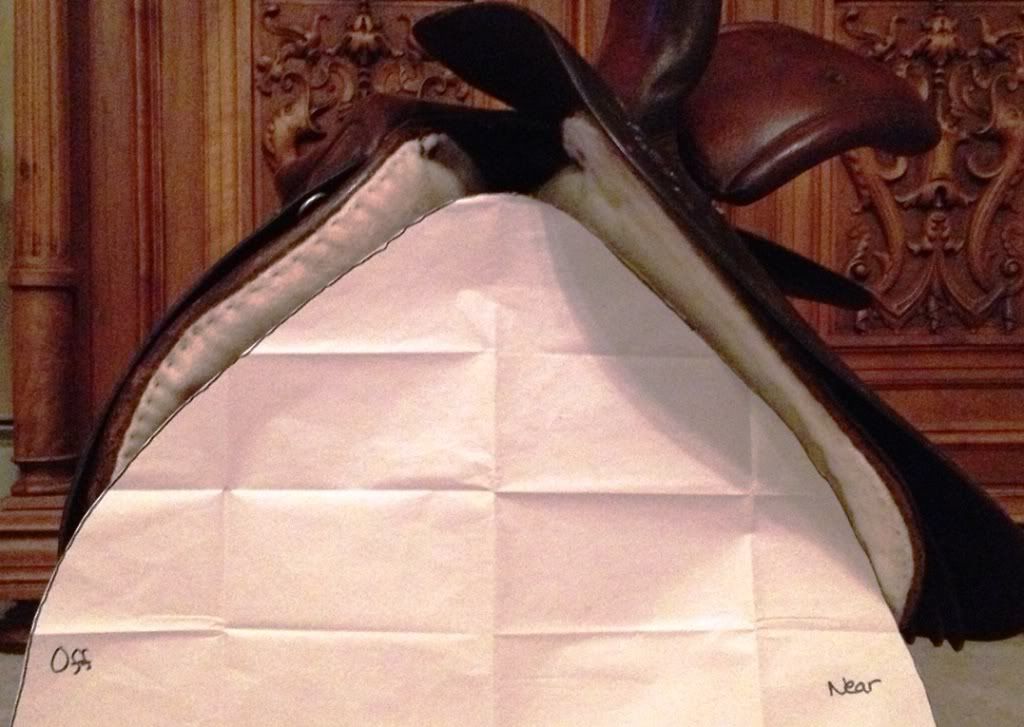
A clear photo of the front of the saddle so I can see the overall shape of the tree and padding for myself.   From this I can tell how much flocking is present and whether the saddle has been flocked heavily to fit a wider tree to a narrower horse.

This diagram shows two saddles with identical trees.  The one on the left has been flocked to try to fit a wider tree to a narrower horse.  This gives it a more defined "neck" to the pommel.  The saddle on the right has less flocking and would fit a round horse better.  I like to think of the difference between the shape of a wishbone and that of a rainbow.  My wide, well sprung horse needs
"less wishbone - more rainbow".


I would also like to see a photo of the underside showing the condition of the panels, photos of the billets on each side, and one of the stirrup fitting or bar on the tree.  It is also important to know what inventory of accessories are being sold with the saddle including the balance strap (with measurement), over girth, stirrup/stirrup leather and fitting, and to get photos of those.  The balance strap may not fit the intended horse, but including these accessories adds to the over all value of the package.  Balance straps are easy to replace, but stirrups and fittings can add up quickly.  Standard, oval eye stirrups are fairly common, but it is always a bonus to get a breakaway stirrup instead.
Up close (and focused) photos of any known imprefections, tears, stains, broken stitching or worn or cracked leather.

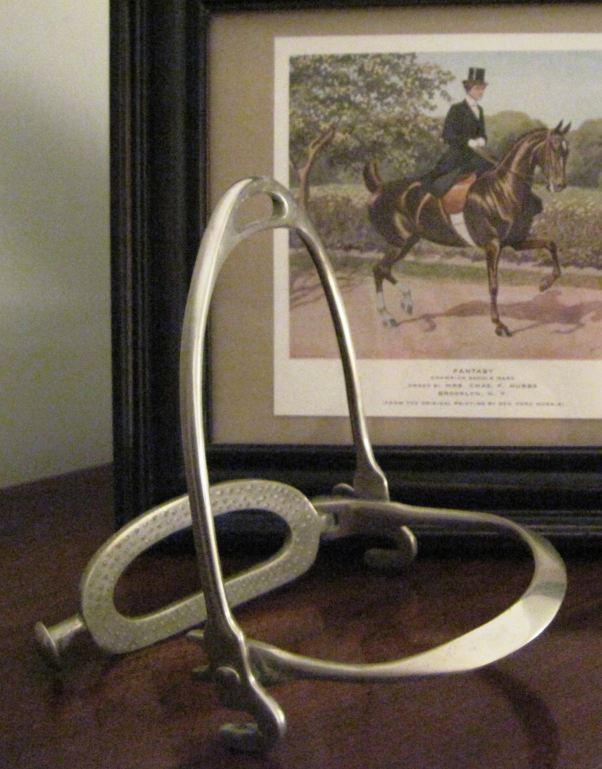
I bought this safety stirrup on ebay two years before I bought my first saddle! 
 It still looks great on a shelf.
Once you have found a saddle that you are considering, send a verified wither tracing to have the seller match it up to the saddle.  Of course, it is always best if the seller is experienced with the challenges of fitting saddles, but at the very least, they should be willing to send you a photo of your tracing held up to the outline of the saddle tree so you can judge for yourself.

Here a seller, Carla Peetros, has sent me a photo of William's
tracing against a M&M which appears to be a close match.
Thank you Carla for allowing me to use this photo.


Because of the difficulty of fitting saddles, it is always a plus to be allowed a trial period with return option.  The buyer buys the saddle, and if it does not fit, they can send it back, at their own cost, for a full or partial refund contingent on the saddle being returned in the same condition.  The Side Saddlery offers this policy, and many sellers dealing with larger numbers of saddles will also accommodate this.  Some sellers just need the saddle to be sold and have a need for the cash and may not be willing to do this which is understandable. 

I will say again that the ladies who have been riding aside for any number of years, as well as some of us "newbies" are a very helpful lot.  They want you to be as happy with your saddle as they have been with their's and for it to be a rewarding experience for all involved.  In my search I have met many helpful people and count them among my friends and fellow horse enthusiasts.  Because of this, I have no doubt the discipline will continue to flourish and provide many with an enjoyable hobby for years to come.


Saturday, December 22, 2012

Tuesday, October 30, 2012

The Placemats in Full Color

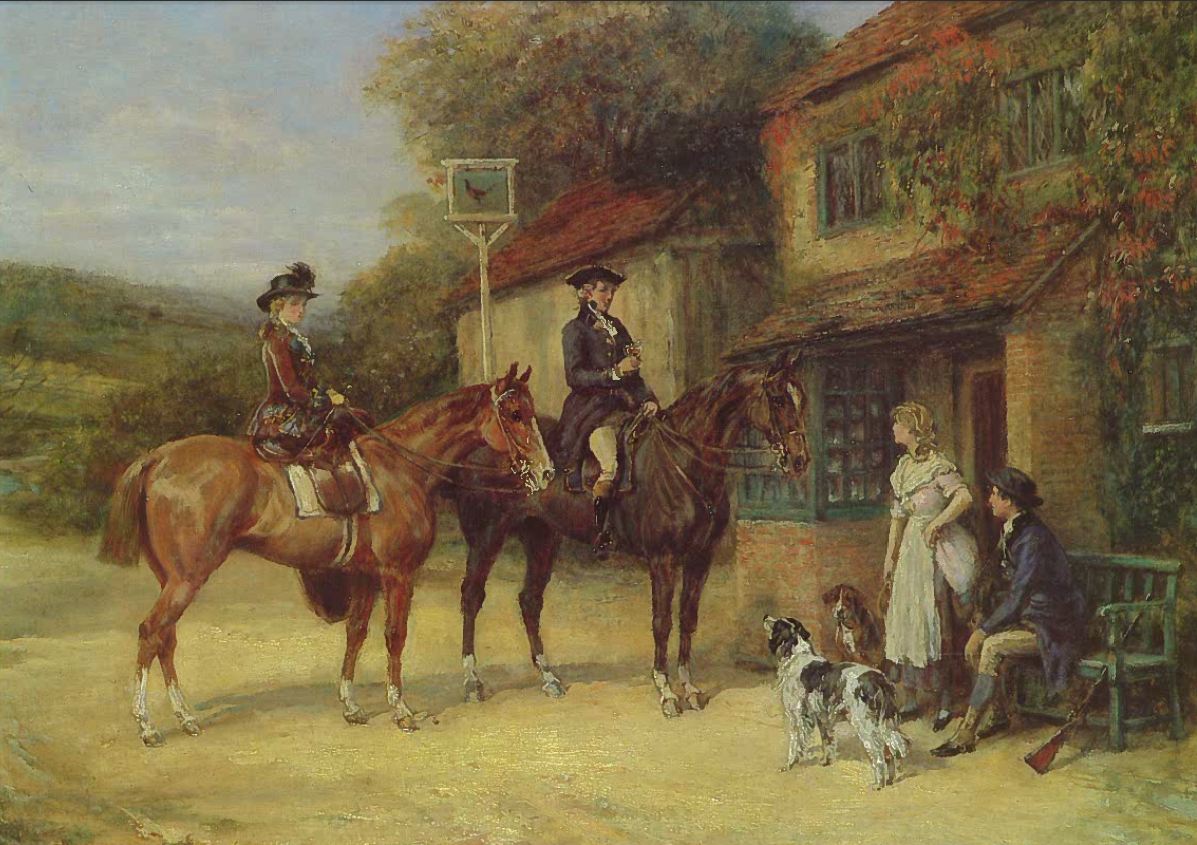
Here are nice image scans of the side saddle images in the placemat set
 
 
A nice grey

 
Stopping at the Inn


Thursday, October 25, 2012

Cleaning Closets

Up until now, my side saddle fund has been $2000.  It has been minorly depleted by shipping the first one in, then off to consignment.  Then shipping the second one in and returning it.  And once I went fox hunting in Virginia which took a nice little chunk out of it....  I have been able to replace it, while also buying related necessary side saddle equipment like girths, long reins, vet wrap and Oakwood conditioner.  But, due to my long legs and my horse's round ribs, it has become apparent that the price range I really need to be shopping in is not the $1500-$2000 range, but the $2500-$3000 range.  I have two possible candidates on the radar in this price range.

With that in mind, I have been hoeing out bookcases, closets, the attic, the basement shelves, in search of under appreciated items that I do not want as much as I want a side saddle.  I've made trips to the consignment shops, listings on Craigs list, Amazon and shortly Ebay to take advantage of America's upcoming festival of spending and self indulgence known as Christmas.  I have been hoarding boxes and padded envelopes, and portioning out my stock of packing peanuts and bubble wrap.  I have denied myself little luxuries like new clippers and tack room clocks. If all goes as estimated, by spring I will have grown my cash stash enough to embark on another saddle shopping spree.

But not to worry, I am still accumulating side saddle treasures.  It seems my mother is also in the midst of "fall clean-up" and I found these gift wrapped and sitting on my tack trunk the other day.


This set of hard board placemats has three side saddle images on them.  I had forgotten they existed, and I am very pleased to have them.  Isn't that the best way to clean your closet?  Get rid of clutter AND give a treasured gift?


Thanks Mom!

Thursday, October 11, 2012

Want List: Riding Whip


Available at the American Saddlebred Museum
  I've had my eyes peeled for a nice "fancy" riding whip for awhile.  Of course I have your usual collection of everyday hunt crops and dressage whips but I was thinking of something a bit more upscale.  I've been looking at stag horn hunting crops, but now this has caught my eye.

It sports the George Ford Morris image "Circus Girl" but reworked so the horse appears grey instead of palomino.


Tuesday, October 9, 2012

George Ford Morris


Vivian Gooch and Madame X .  Vivian Gooch was an Englishman
who judged the National Horse Show at the Garden in 1918


One of my favorite pastimes as a child was pouring over horse books.  One of my favorites was “Portraitures of Horses” which was a large, leather bound volume containing the bulk of the life’s work of renowned equine artist George Ford Morris.  GFM was born in 1873 and died in 1960.  He discovered his passion for art as a child and his life’s work spans the golden age of the horse in America.  He made portraits of all the famous horses and personalities of the day. Although he himself owned American Saddlebreds, his work includes American Saddlebreds, Thoroughbreds, Standardbreds, Morgans Arabians, draft stallions and hitches, coaching breeds, personal hunters and pets and prize winning cattle.  The human subjects, the owners and riders, are among the elite and wealthy families of the day.   Some of my favorites are featured on horse show posters and magazine covers.  I believe this is the origin of my love for illustration art, particularly that of the 1920s.

Art for a Horse Show Poster The National 1910

Because this is a side saddle blog…  and because this entry is prompted by the new item offered by my favorite gift shop at the American Saddlebred Museum,

Lampshade featuring Mary Fisher and Royal Irish

 I have rounded up a collection of his work featuring ladies aside.  In fact, this image,cooincidenatlyl, is the same one I featured on a recent Blog entry when one of Mary Fisher’s side saddles came up for sale on Ebay.  

Miss Bull on Lady Bonnie


I have clipped many quality George Ford Morris images from the web over the years.  Some of these, I am privileged enough to own in some hard copy format such as prints, horse show posters, playing cards, magazines or magazine over runs and vintage calendars.  My friend who owns Saddlebred Memories makes a few prints of pieces she owns originals of and whenever she makes these available, I snap them up immediately.  The American Saddlebred Museum has recently opened an expansion to hold a gallery of his work, which is on my short list of “places to visit as soon as possible”.


Here is a brief George Ford Morris biography I found on the web Link

"Circus Girl"

There are a couple of collectors who own good portions of his estate.  As you can see here Link, he was also an amazing sculptor, although I am aware of only a few pieces.  One Ebay seller often offers items for sale on Ebay with correct provenance from the Estate, and I am happy to bid on them whenever they come up.

Mrs. Francis Garvan on her hunter Alert.

Original oil paintings come up at auction regularly and can be had for anywhere from $5,000 to upwards if $20,000... maybe some day.


This little print of "Fantasy"and Mrs. Charles Hubbs graces a chest of drawers in my home.
  

This one of Princess Sonia almost appears to be a companion piece.


One of my favorites, above, was comissioned for a riding school calendar.


And this one for an Armour catalog.


Laramees Harness

His advertising pieces are the most rare.


And even a simple pencil study can be valued at several hundred dollars. 
My passion for George Ford Morris Art is greater than my passion for side saddle.  Or, perhaps, they are one and the same.

Monday, September 24, 2012

Hankerchief Slits Revisted

 This is what I love about blogging:  There are people out there, who know more than I, whom I have never met, reading it... and they're willing to share their stuff!!!

These two wonderful vintage photos come to us from the collection of Jeannie Whited.  I just love them.  These smartly turned out ladies each give us a glimpse into the past.  And, they are each sporting a hanky in their hanky slit.

Circa 1880s?
The photo above also shows some interesting off side straps.  When I questioned Jeannie as to their purpose she responded that she thinks they would have been used for a raincoat.  She has some other photos with them shown.


Circa 1910?
How do you supposed this gal keeps her bowler on at that angle?  I don't see a hat cord (which would anchor it to her collar in case it flew off) so my guess is some serious hat pins?
I really like her long and lean little horse.  Plenty of room there for a side saddle.

Thursday, September 20, 2012

Miss Mary V Fisher

Presently on Ebay, there is a very nice side saddle for sale.  Listing Here.

This auction was posted on Facebook by Leila, and Nick Creaton identifies the saddle as a Whippy Ladies Show Saddle No 5. First marketed in the 1920's.

Picture from Ebay listing for posterity


The first thing you will note about this saddle, besides that it is in lovely condition, is the very pared down off side flap.  This identifies it a show saddle specifically designed to minimise the saddle's profile on the horse.  Looks like you would have to be careful about what type of saddle rack you put it on.


Picture from Ebay listing for posterity


Actually, the first thing I noticed about the listing is that this saddle was owned by Miss Mary V Fisher of Dixiana Farms.  And that, to a student of American Saddlebred history, is the most fascinating part.

Mary Fisher was the daughter of Charles T and Sarah Fisher. Charles Fisher was one of the owners of Fisher Body, a Detroit car body builder. 
In 1928, when Mary was 15, he purchased the Lexington Thoroughbred breeding farm Dixiana.  Besides becoming influential in horse racing, Miss Mary, like many socialites of the day, bred, rode and showed American Saddle Horses.


From Famous American Saddle Horses Vol III by Susanne

In fact, she excelled at it.  In 1936, she was the first woman rider to win a Championship Stake class at the World Championship Horse Show at the Kentucky State Fair.  She won the 3-Gaited Horse over 15.2 on a horse called Royal Irish.  I believe she repeated this in 1937 or 1938.  There would not be another woman to win such a prestigious open class until Jean McLean Davis won the 3-Gaited World's Grand Championship in 1989 aboard Gimcrack.  Mary Fisher was the first saddle horse rider inducted into the National Horse Show Hall of Fame in 1986.


Miss Mary Fisher aboard Royal Irish painting by George Ford Morris

Miss Fisher was very active showing Saddle Horses in the 1930s and into the 1940s.  Eventually she became more focused on Thoroughbred racing.  I am pleased that one of her saddles has been so well preserved and retains it's identity. 

And, because I just love 1920s illustration art, below are a few fun 1920s Body by Fisher ads for her father's company.  The company continued into the 1980s when it was absorbed into General Motors.


Sunday, September 16, 2012

Tuesday, September 11, 2012

Measuring the Rider for a Side Saddle

In our search for a saddle to correctly fit the unique individual curves of our horse's backs, we must not forget to find just the right fit for the rider. As a taller person (5' 9") with long legs and a curvy figure I am on the lookout for a larger than average saddle.  I am told, and have experienced this myself, that each make of saddle will ride just a bit differently as far as size.   My first saddle was well broken in and there was a distinct "sweet spot" in the seat which drew my seat bones in.  My M&M saddle measured 22.5" and I felt that I was right at the back of the cantle.  The 23" long Mayhew felt as if I had ample room, much more dramatic than a mere half inch.

The trick is to measure the length of your thigh from the back of your buttocks to the bend of your knee.  The following link to the ISSO website shows the tried and true standard method of estimating what seat length will work for you.


Finding a surface to sit on that will place you firmly upright against a wall but keep your thigh horizontal while not interfering with the way your leg will naturally hang is tricky, as is measuring the length of your thigh yourself.  Deb Smith of the Side Saddle Connection has reverse engineered this idea and come up with what I think is an easier method.  I was able to duplicate this on my own coffee table and found it to be so much easier to actually do myself. 


Photo courtesy of Deb Smith The Side Saddle Connection

 *  sit on a flat surface with lower leg over the front edge (eg: a low table, tack box, saddle stand with a flat  top, as you would sit in a saddle)

*  push a right angle object, such as a weighted box back until the back of your knee is against the flat surface. The box is weighted so it doesn't move or twist when the rider stands up.  (my note**: The box should be quite tall, but I think if you got it too tall leaning back could skew your results.  Belt height would seem to be most accurate.)


Photo courtesy of Deb Smith The Side Saddle Connection

* Measure the length shown by the blue line, this will give the riders leg length
Jeanne Cracknell, also of the Side Saddle Connection, states that she believes that in order to not hang off the back edge of the seat, you should still add 1" to your overall number.
When I measured myself using the wall method, I came up with 22.5".  This was confirmed by sitting in both 22.5" and 23" measured saddle seats.  Using Deb Smith's method I got 21" to 21.5".  Adding an inch makes my likely measurement 22.5" which is consistent with the wall method resuls, but, the box method is so much easier to set up and do yourself.

Jeanne Cracknell and Debbie Smith joined forces in The Side Saddle Connection in order to provide riders with the best possible advice in regards to Side Saddle fitting and riding. They offer clinics, saddle sales, fittings and demonstrations.  My thanks to them for their providing this info and the photos used.